This is a modified version of a short story I wrote in sixth grade English class, based on (and parodying) Greek mythology. Enjoy!
Hephermes, Greek God of Cars
by Sevin Kwon
In ancient times, the gods and goddesses of Mount Olympus had had it all. The Greeks adored them and worshipped them, presenting them with sacrifices and honoring them with festivals. Thus the gods were always busy, constantly keeping up with the tasks that their divinity demanded. But all that changed when the Greeks converted to Christianity and stopped believing in the old gods. With nobody to worship them and nothing to do, the gods became very depressed.
Two of the gods, Hermes and Hephaestus, were especially hard-hit. Hermes had been tasked with ferrying souls to the underworld, but he could no longer do that because Jesus Christ had saved most of them. Hephaestus had spent his time shaping gold and silver into fine jewelry for the gods, but the other gods didn’t want them because they were also depressed. Unable and unwilling to stay bored any longer, the two gods headed down to Hephaestus’ old forge in the heart of a volcano. They decided to create a statue of one of them and imbue it with life, creating a new god for their amusement. But Hermes and Hephaestus couldn’t agree on whom to make a statue of, so in compromise, the new god had the upper body of Hephaestus and the lower body of Hermes.
Hephermes, as the new god took to calling himself, had the strength and craftsmanship of Hephaestus and the natural speed of Hermes. As all Greek gods do, he stepped down and took a visit to see how they were doing. Hephermes was dismayed to find how long the mortals took to get from place to place: by walking, riding a horse, or even riding a chariot, it always took them several long days to get from Athens to Corinth and so on. Taking pity on the mortals and wanting to improve their condition, Hephermes returned to the forge and worked day and night on a new invention to solve their problems.
The next morning, Hephermes descended upon the marketplace in Athens in all his glory. The mortals were panicked, believing that Hephermes was either a demon or Christ’s second coming. When Hephermes explained that he was neither, the mortals calmed down, and Hephermes took a moment to explain his new invention.
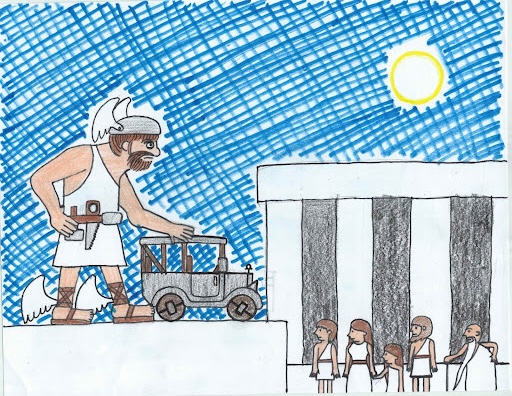
“This is a car,” he explained. “It looks just like a chariot, but it has four wheels so it’s more stable. You use this wheel inside to steer, and these two oil lamps in front of you to see where you’re going at night. You press on this thing with your foot to stop, and this thing to go.”
“How do you make it go?” Asked one of the mortals. “It doesn’t have any horses!”
“That’s the best part,” explained Hephermes. “The car doesn’t need horses. It can move on its own! It runs on oil that comes out of rocks. I’ve set up little shrines on the sides of roads all around Greece where, if you leave an offering of coins for me, you can fill your car with more oil. The car can travel faster and farther than any animal or chariot that exists. Buy one and see for yourself!”
And when Hephermes stopped speaking, the entire crowd in the marketplace forgot about what they were doing and rushed to his stand to buy a car. Hephermes eventually settled down and established the world’s first car dealership, where anyone who could afford it could buy their own car. Even though these early cars could only go a paltry twenty miles per hour, cost two year’s wages, and didn’t have CD players, they still sold extremely well. People from all over Greece, and eventually all over the Roman Empire, traveled to Athens to buy Hephermes’ cars. Hephermes was generous enough to share the secret of car manufacturing to the mortals, so that in a few years, most of the chariot shops in the Empire had converted to car dealerships.
Within twenty years, the car was widespread within Greece and fairly common in the rest of the Empire. Super-highways connected the provinces, with thousands of cars zipping from city to city and filling up at Hephermes’ oil shrines. Restaurants featured drive-thrus where people could order gyros and baklavas from the comfort of their cars. There were even drive-in theaters, where drivers parked their cars to watch plays and gladiator games. The Greek Orthodox Church condemned the car industry because it promoted the worship of a pagan god, but most of the people didn’t care. They enjoyed their cars and their new lives too much.
But there was one serious problem. There were few to no laws regulating cars or drivers. Every day the news scrolls would feature some incident of a little boy stealing his dad’s car and crashing it, or something like that. Hephermes realized that there needed something to be done to license drivers, register vehicles, and regulate the car industry. For this reason he established the DMV, or the Department of Mortal Vehicles. Hephermes built an enormous temple as its headquarters, chose the 100 most punctual men he could find to be employees, and arranged for all of them to show up at sunrise to the grand opening of the DMV.
But when the big day came, all of the DMV workers showed up three hours late. When the workers finally showed their faces, Hephermes was enraged.
“I chose you because you were the most punctual men in the world,” said Hephermes. “But somehow, you still showed up late! For this you must suffer my wrath!”
“Have mercy,” pleaded the DMV workers. “We meant no harm! Please don’t fire us!”
“Silence!” Roared Hephermes. “I will let you keep your jobs. But as punishment for being slow to come to the opening, you and your descendants shall be slow for all eternity!”
And that is why service at the DMV is so slow.
 Mark Starman in the 21st Century
Leave a comment